



In retail inventory management, holding onto dead stock is not a neutral act; it actively burns working capital. Every square foot of shelf space dedicated to an unpopular blind box series that hasn’t sold in 90 days is space stolen from a high-velocity, high-margin new release. Liquidating this aging inventory is a financial necessity, but the physical method of liquidation can either protect or destroy your boutique’s brand equity.
When discounting blind boxes, store owners face a critical visual merchandising decision: do you leave the clearance items neatly organized on standard shelving with a red sale tag, or do you toss them into a high-volume “Dump Bin”? Based on retail psychology and conversion data, executing the correct clearance display dictates how quickly you recover your cash. In this B2B guide, we will break down the danger of price cannibalization, the psychology of the “treasure hunt,” and the ultimate SOP for liquidating dead blind box stock.
The Danger of the “Neat Clearance Shelf”
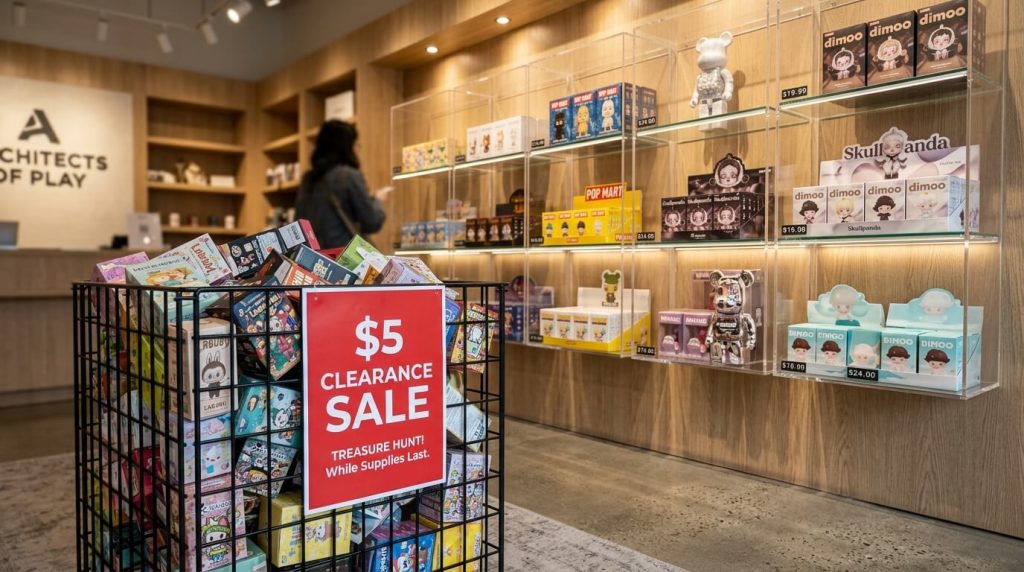
Many independent retailers simply slap a “50% Off” sticker on a slow-moving blind box and leave it sitting on the pristine acrylic shelf right next to a brand-new, full-price series. From an operational standpoint, this is a catastrophic merchandising error.
The Price Anchoring Trap: When a customer sees a $7.50 clearance box perfectly aligned next to a $15.99 new release, it immediately anchors their perception of value. The new release suddenly feels overpriced. You condition your local collector base to stop buying full-price drops and instead wait for the inevitable neat clearance shelf. This phenomenon is known as brand cannibalization. Clearance inventory must be physically and aesthetically segregated from your premium, full-margin goods.
The Psychology of the “Dump Bin”
The “Dump Bin”—a large wire basket or deep acrylic bin filled chaotically with discounted items—is the most effective physical liquidation tool in retail. It works by triggering entirely different consumer psychology.
- The Treasure Hunt (Tactile Engagement): A neat shelf says, “Look, but don’t touch.” A dump bin demands physical interaction. Shoppers must dig, sift, and move boxes to see what is at the bottom. This tactile engagement triggers a dopamine loop. When a customer “discovers” a series they vaguely like buried at the bottom of the bin, it feels like a personal victory, accelerating the impulse to buy.
- The “Bargain” Aesthetic: The chaotic nature of a dump bin visualizes a heavy discount. It implicitly communicates to the customer: “These are the leftovers, which is why they are cheap.” This protects the premium status of your neatly organized, full-price wall.
Operational Hazard: The “Crushed Box” Liability
While dump bins are highly effective for conversion, they introduce a severe logistical hazard: structural damage. When 100 cardboard blind boxes are tossed into a bin and constantly rummaged through by teenagers, the sharp corners will inevitably crush and tear the outer packaging.
As detailed in our guide to handling damaged blind boxes, a crushed box loses its “giftable” value. To mitigate this risk, never put heavy PVC items on top of fragile boxes in the bin. Monitor the bin daily and remove any boxes that have become severely compromised.
The Ultimate SOP: The “Lucky Bag” (Fukubukuro) Strategy

If you have heavily aged dead stock or boxes that have already suffered shipping damage, the absolute best method for dump bin liquidation is the Japanese Fukubukuro (Lucky Bag) strategy.
The Operational Workflow:
- Take your slow-moving inventory and completely discard the outer cardboard packaging.
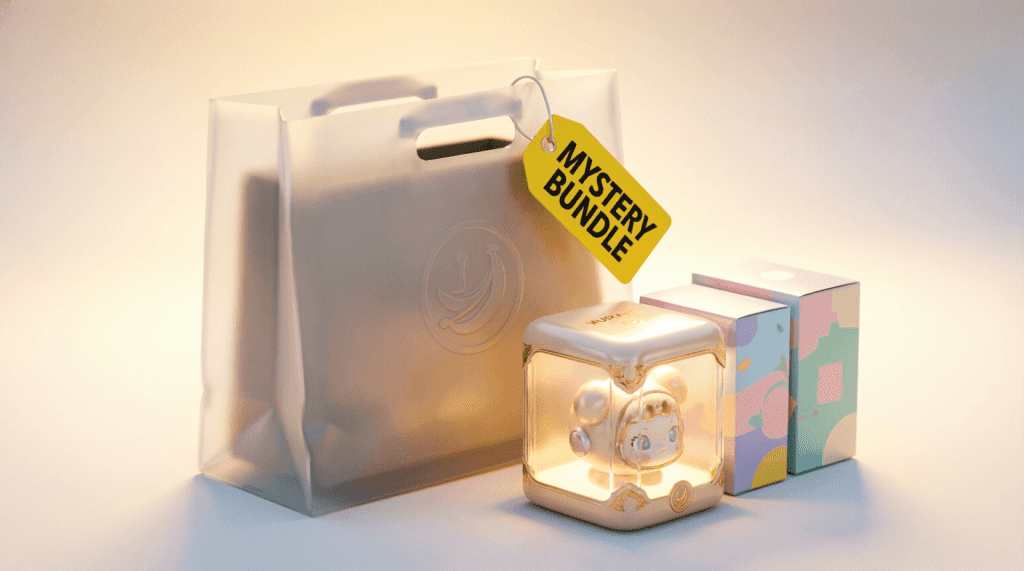
- Take the sealed, opaque foil bag (containing the figure and character card) and place it inside a generic, custom-stamped paper bag.
- Staple the paper bag shut and write “$5 Mystery Pull” or “B-Grade Surprise” on it.
- Toss these generic paper bags into your dump bin.
This strategy is brilliant because it completely obscures the unpopular IP. You are no longer selling an unpopular “Series X” figure; you are selling the pure, cheap thrill of a $5 gamble. This is the fastest known method for liquidating dead stock in a retail setting.
Store Layout: Where to Place the Clearance Bin
Placing a messy dump bin immediately at your front entrance destroys your boutique’s premium first impression. You must utilize strategic zoning.
Referencing our analysis of retail heat maps and display zones, the optimal placement for a clearance bin is the Checkout Queue (POS Zone).
When customers are standing in line waiting to pay for a full-price item, their purchasing resistance is at its lowest. Placing a dump bin of $5 to $8 clearance items directly next to the line exploits the psychology of the checkout counter. The customer digs through the bin to pass the time and adds a clearance box to their cart as a low-friction impulse add-on, increasing your Average Order Value (AOV) effortlessly.
Liquidation Strategy Matrix
Use this matrix to train your management team on how to execute clearance markdowns without damaging the store’s core profitability.
| Liquidation Method | Visual Aesthetic | Brand Impact | Best Retail Use Case |
|---|---|---|---|
| Neat Shelf w/ Sale Tag | Premium but confusing | Negative (Cannibalizes full-price sales) | Slightly discounting a premium 400% figure (Not for blind boxes). |
| The Dump Bin (Original Boxes) | Chaotic, bargain-driven | Neutral (Segregates the discount) | Clearing out the last 10-15 boxes of a retiring PVC series. |
| The “Lucky Bag” Dump Bin | Mysterious, highly engaging | Positive (Creates a fun event) | Aggressively liquidating severely unpopular or damaged dead stock. |
Часто задаваемые вопросы (FAQ)
Should I mix different IPs and series together in the dump bin?
Yes. A dump bin works best when it is a true mix of merchandise. Mixing a few slightly popular items (that you only have 1 or 2 left of) in with the dead stock incentivizes customers to dig deeper. If the bin is entirely filled with one unpopular series, the “treasure hunt” illusion is broken.
How deep of a discount is required for a dump bin?
The visual of a dump bin implies a heavy discount. Putting items in a dump bin for 10% off will anger customers. Standard retail practice for a dump bin is selling at cost or slightly below cost (usually a 40% to 60% discount off MSRP). Remember, the goal of liquidation is not to make a profit; the goal is to recover trapped cash so you can reinvest it into fast-moving inventory.
Can I put plush blind boxes in a dump bin?
Absolutely. In fact, foil-bagged plush keychains are the best items for a dump bin. Because they are soft, they do not crush or suffer structural damage when rummaged through by customers, completely eliminating the “crushed box” liability associated with cardboard PVC boxes.
How do I avoid acquiring dead stock in the first place?
Dead stock usually occurs when retailers are forced by factories to meet massive Minimum Order Quantities (MOQs) on unproven IPs. Sourcing through a reliable B2B aggregator allows you to order mixed master cartons, testing local demand before over-committing capital. Platforms like Kidults Box provide the flexibility required to keep your inventory lean and profitable.
Executing a ruthless, efficient clearance strategy ensures that your working capital is never trapped in stagnant inventory. If you have successfully liquidated your dead stock via the dump bin strategy and are ready to reinvest in high-velocity, trending blind boxes, exploring a curated wholesale catalog is your next step.