





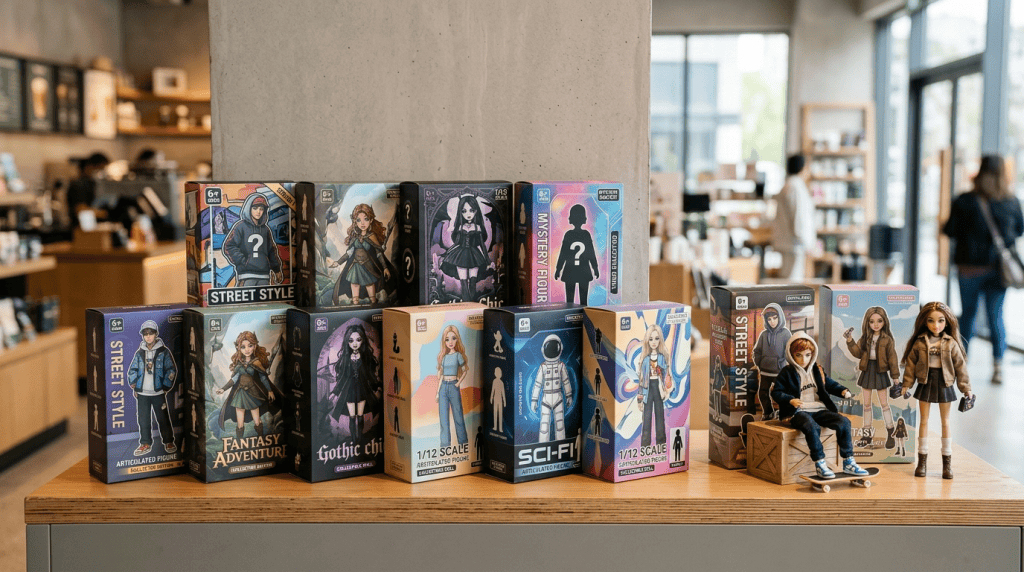
Choosing articulated doll collectibles for a store means looking past character artwork and launch buzz. Scale accuracy, joint construction, outfit complexity, assortment design, package condition, and replenishment potential all affect whether a series works at retail. When comparing new 1/12 BJD blind boxes, the practical goal is not to find one universal winner. It is to identify the series that fits your customers, price architecture, display space, and inventory tolerance.
The labels BJD and MJD are also used inconsistently across listings. Before you commit budget, confirm the actual joint system, body material, included accessories, doll dimensions, and assembly requirements rather than making a purchasing decision from an acronym alone.
What “Best New” Should Mean for a 1/12 BJD Series
A newly listed series is not automatically a strong retail buy. “Best” should mean commercially suitable for a specific channel: a collectible store may prioritize expressive bodies and customization, while a gift retailer may care more about ready-to-display styling and recognizable visual themes.
These products may fit several buyer profiles:
- Designer-toy retailers: customers may respond to character identity, secret designs, and display collectibility.
- Doll and hobby stores: buyers may ask about articulation, removable clothing, compatibility, and customization.
- Gift shops: shelf presentation, understandable themes, and gift-ready boxes can matter more than technical doll terminology.
- Online sellers: consistent product photography, sealed packaging, unit dimensions, and fulfillment protection are especially important.
- Convention and pop-up sellers: compact inventory and immediate visual impact may be priorities, but damaged packaging can reduce impulse appeal.
Start by defining the target customer and expected retail position. Then ask whether the series is genuinely new to the supplier, newly restocked, or simply new to your catalog. Confirm the edition or series name in writing so that an older and newer release are not confused during quotation.
Compare the Doll, Assortment, and Selling Format Together
A useful shortlist evaluates the complete retail unit rather than only the face sculpt. Use the following table when reviewing listings, samples, or supplier quotations.
| Evaluation point | What to confirm | Why it matters to a retailer |
|---|---|---|
| Scale and dimensions | Standing height, seated height, head size, and packaged dimensions | “1/12” may not communicate exact shelf space or compatibility. |
| Joint construction | Joint type, range of movement, assembly status, and whether parts detach | Articulation affects posing, customer expectations, and handling instructions. |
| Body and face materials | Materials for the body, hair, face, eyes, clothing, and accessories | Material information supports accurate listings and more meaningful quote comparison. |
| Design count | Regular designs, possible secret design, and whether ratios are stated | The assortment structure influences duplicate risk and collector interest. |
| Included contents | Clothing, shoes, wig or hair parts, stand, accessories, cards, and instructions | Similar-looking products may include materially different component sets. |
| Case configuration | Units per sealed case and whether a case is intended to contain different regular designs | Case structure affects live selling, full-set sales, and duplicate expectations. |
| Retail packaging | Box dimensions, seals, inner protection, labeling, and barcode availability | Packaging influences shelf presentation and warehouse handling. |
| Reorder status | Whether the quoted series is active, limited, restocked, or subject to availability | A successful test is less useful if the same release cannot be replenished. |
For concrete series research, retailers can examine the presentation and sourcing questions in the Luluya Cloud Feather Pavilion BJD buying guide and the Sakura Vision Reconstruction 1/12 guide. These are useful starting points for a shortlist, but current specifications and commercial availability should still be confirmed in the quote.

How the 1/12 Scale Changes the Retail Decision
Scale affects more than display size. Customers may expect 1/12 dolls to work with miniature scenes, furniture, clothing, or accessories, but compatibility should never be assumed from the scale label alone. Head proportions, shoe size, body width, connector design, and stylized anatomy can vary.
Ask for measurements in millimeters or centimeters and request photos showing the doll beside a ruler when compatibility matters. If loose clothing or interchangeable parts are an important selling point, confirm which components are removable and whether changing them requires disassembly.
Scale comparison also helps prevent catalog errors. A 1/6 doll occupies a different price, shipping, and display position from a 1/12 product. Retailers exploring both formats can use the Bonnie 1/6 retail sourcing guide as a comparison point rather than treating all articulated blind box dolls as interchangeable.
Buyer action: prepare one specification sheet per candidate series. Record doll height, package size, joint type, materials, contents, and case configuration using supplier-confirmed information.
Case Packs Can Decide Whether a Doll Series Is Testable
MOQ and case quantity are separate questions. A supplier may quote by unit, sealed case, or master carton, and the minimum order may cover one SKU or several eligible products. Ask how many individual blind boxes are in a series case, how many cases are in a master carton, and whether cases remain factory sealed.
A sealed series case may be preferable when customers want a possible regular set or when a retailer sells complete cases. Mixed loose units can support a smaller trial, but they may provide less certainty about assortment composition. The practical differences are explained further in this guide to sealed series sets versus mixed blind box assortments.
As a planning example, a retailer testing 24 units might allocate 12 to a physical display, 8 to online fulfillment, and 4 to live selling. Those numbers are not a suggested MOQ; they simply force the buyer to check whether the supplier’s case pack fits the intended sales channels. Also decide whether opening one unit for photography or display will leave enough sealed stock to sell.
Before accepting an MOQ, ask:
- Does the minimum apply per series, per design family, or to the total order?
- Can different qualifying products be combined?
- Are units supplied as sealed series cases or repacked assortments?
- Could the order contain units from different releases or production batches?
- What carton dimensions and gross weight apply to the planned quantity?
If you are building a test order, send the intended channel mix and desired sealed-case count with the inquiry. That gives the supplier a clearer basis for confirming the appropriate packing format.
Why Freight and Reorder Timing Matter for Articulated Dolls
Unit price alone does not show whether a 1/12 doll series fits the retail budget. Estimate landed cost using the quoted merchandise total plus international freight, insurance if applicable, duties or taxes, customs-related charges, payment costs, and domestic delivery. Divide the combined estimate by the number of saleable units, not merely the number ordered.
Packaging volume can make two similar quotations perform differently. Request carton count, carton dimensions, gross weight, and shipping terms before comparing offers. Buyers should also clarify which party is responsible for freight arrangements, import procedures, and destination charges.
Lead-time questions should separate three stages: order preparation, transport, and local receiving. Avoid treating an estimated dispatch date as a guaranteed arrival date. Customs processing and destination delivery can vary, so buyers should verify requirements and build contingency into launch plans.
For reorder planning, set a trigger based on sales velocity and replenishment uncertainty. As a planning reference, a store selling 4 units per week with 12 units remaining has roughly three weeks of stock before allowing for returns, display units, or sales spikes. The buyer should ask about current availability before using that calculation because a blind box release may not remain reorderable.
Protecting Small Doll Parts and Retail Boxes in Transit
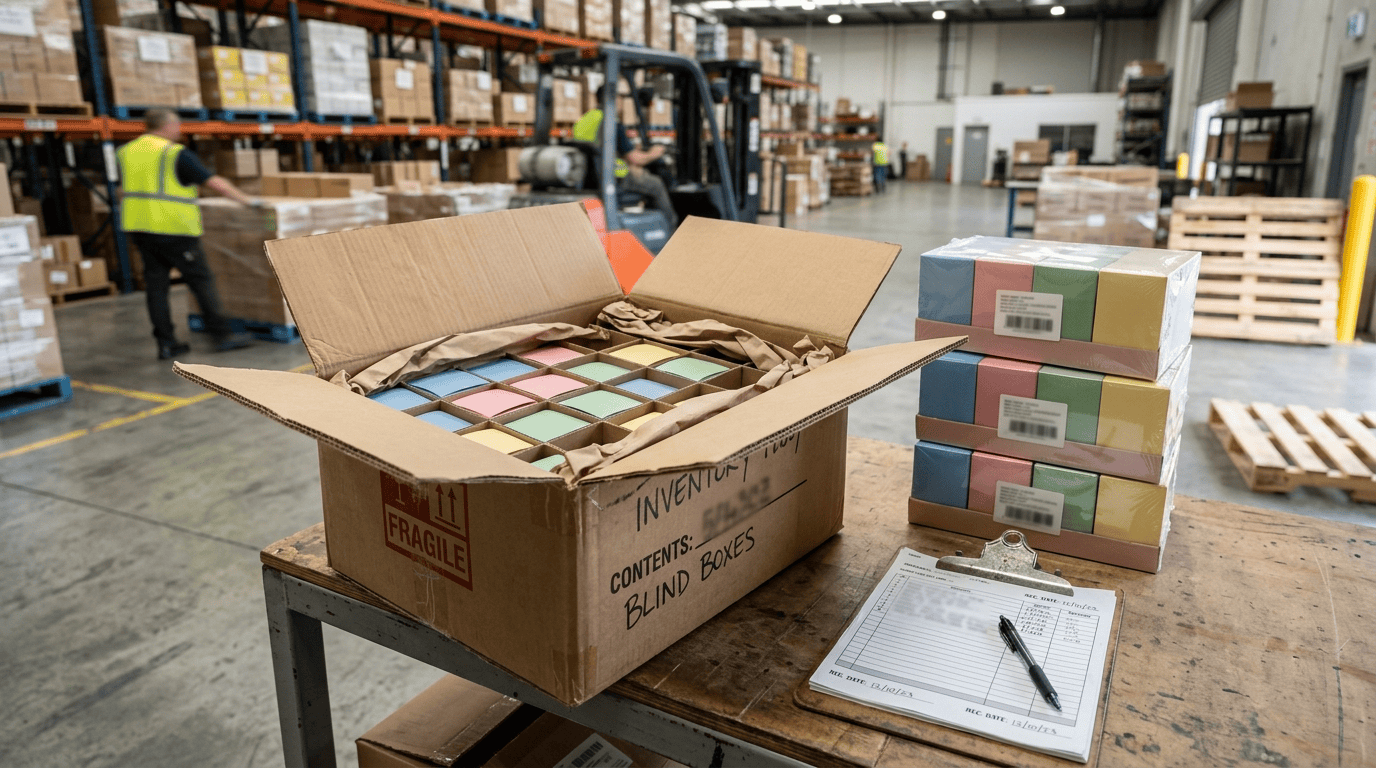
Articulated dolls can combine painted faces, joints, clothing, shoes, and small accessories in one package. A sample review should therefore check both cosmetic presentation and completeness. Ask whether the inner tray or protective bag restricts movement and how retail boxes are protected inside the shipping carton.
Use a repeatable receiving check:
- Photograph unopened cartons and note visible crushing, moisture, or punctures.
- Count cases and units against the packing document.
- Check seals, box corners, and assortment labels.
- Inspect an agreed sample for paint condition, joint function, clothing placement, missing parts, and accessory completeness.
- Record issues by quantity and type before contacting the supplier.
Request clear packaging and labeling images before payment, including warnings, age grading, importer information fields, barcodes, and instruction language where relevant. Product safety, labeling, intellectual-property, and import obligations differ by destination. Buyers should verify applicable requirements with qualified local resources rather than assuming that packaging suitable for one market is acceptable in another.
Warning Signs Hidden in an Attractive BJD Quote
A low unit price should not compensate for an unidentifiable product or incomplete commercial terms. Pause the comparison when a quotation omits the exact series, scale, units per case, package condition, or shipping basis.
- Ambiguous BJD or MJD terminology: request a construction description and photos instead of relying on the label.
- No distinction between sealed and loose units: ask how products are sourced and packed.
- Only promotional images are available: request current package photos and, when practical, sample details.
- The quote changes the series or edition silently: restate the full product name on the purchase document.
- Secret-character claims lack a stated source: do not advertise ratios or guarantees unless they are documented.
- Carton data is missing: landed-cost and freight comparisons are not ready.
- Pressure to pay before specifications are confirmed: resolve product, quantity, packing, and shipping questions first.
Another common mistake is comparing a loose-unit quote with a sealed-case quote as though they are identical. Normalize every offer to the same requested product, quantity, packing format, shipping basis, and included services.
Send a Quote Request That Identifies the Exact Doll Series
A structured inquiry reduces follow-up and makes competing offers easier to compare. Buyers can adapt this template:
Hello, please quote the following 1/12 BJD or MJD blind box series: [full series name]. Please confirm the doll height, joint construction, primary materials, included accessories, number of regular designs, and whether a secret design is possible. Please also state units per sealed case, cases per master carton, applicable MOQ, packaging condition, carton dimensions, gross weight, order-preparation estimate, shipping terms, and quote validity. Please provide current retail-package photos and available labeling information. The destination is [country/postcode], and the planned sales channel is [store/e-commerce/live selling].
Attach a checklist covering the following points:
- Exact brand, series, release, and scale
- Requested unit and sealed-case quantities
- Need for a sample or display unit
- Body, face, hair, clothing, and accessory materials
- Joint construction and assembly status
- Case assortment and secret-design wording
- Retail box and master-carton data
- Destination and preferred shipping basis
- Required documentation and labeling questions
- Procedure for reporting missing, damaged, or incorrect items
Before committing inventory budget, request a written quote based on the same specification sheet for every candidate. Compare the delivered commercial format—not just the doll image or per-unit number—and resolve any missing case, packaging, or shipping details before payment.
FAQ
What is the difference between a BJD and an MJD blind box?
Terminology can vary between brands and sellers. Buyers should request a description of the joint mechanism, body material, assembly method, and articulation rather than assuming that every BJD or MJD label refers to the same construction.
Are all 1/12 BJD blind boxes compatible with the same accessories?
No compatibility should be assumed from scale alone. Confirm body measurements, head size, foot size, connector design, and clothing dimensions before advertising compatibility with furniture, outfits, shoes, or replacement parts.
Should retailers order sealed cases or individual blind boxes?
Sealed cases may suit full-set sales and collector expectations, while individual units may reduce the size of a test. Ask how each format is packed, whether the assortment is traceable, and whether the MOQ differs.
How should a retailer compare wholesale BJD quotes?
Compare the same series, quantity, case format, included contents, carton data, shipping terms, and destination costs. A unit price is not comparable when packaging or freight responsibility differs.
What should be inspected when BJD blind boxes arrive?
Check carton condition, quantities, seals, retail boxes, assortment labels, paint presentation, joint function, clothing placement, and accessory completeness. Record any issues with dated photos and quantities.
Before Adding a New Doll Series to the Shelf
The strongest retail choice is the series whose specifications, case structure, packaging, delivered cost, and replenishment risk match the intended channel. Confirm what “1/12,” “BJD,” and “MJD” mean for each product, document the exact release, and compare written quotations on equal terms. That process is more dependable than selecting stock from character artwork or launch language alone.

